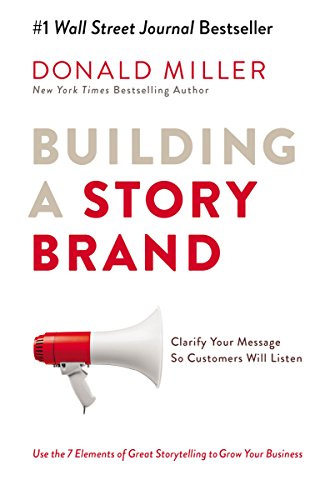
Building a StoryBrand
Quotes and highlights from Building a StoryBrand by Donald Miller — 151 passages I marked up while reading (March 2024). Everything below is taken straight from my Kindle, unedited and in the order I read it.
What this book keeps circling back tocustomers, villain, one-liner, customer, brand and hero.
All 151 highlights
Marketing has changed. Businesses that invite their customers into a heroic story grow. Businesses that don’t are forgotten.
But what if the problem wasn’t the product? What if the problem was the way we talked about the product? The problem is simple. The graphic artists and designers we’re hiring to build our websites and brochures have degrees in design and know everything about Photoshop, but how many of them have read a single book about writing good sales copy? How many of them know how to clarify your message so customers listen? And worse, these companies are glad to take your money, regardless of whether you see results or not.
So what’s your message? Can you say it easily? Is it simple, relevant, and repeatable? Can your entire team repeat your company’s message in such a way that it is compelling? Have new hires been given talking points they can use to describe what the company offers and why every potential customer should buy it? How many sales are we missing out on because customers can’t figure out what our offer is within five seconds of visiting our website?
when we ramble on and on about how we have the biggest manufacturing plant on the West Coast, our customers don’t care. Why? Because that information isn’t helping them eat, drink, find a mate, fall in love, build a tribe, experience a deeper sense of meaning, or stockpile weapons in case barbarians start coming over the hill behind our cul-de-sac.
Mistake Number One The first mistake brands make is they fail to focus on the aspects of their offer that will help people survive and thrive. All great stories are about survival—either physical, emotional, relational, or spiritual. A story about anything else won’t work to captivate an audience. Nobody’s interested. This means that if we position our products and services as anything but an aid in helping people survive, thrive, be accepted, find love, achieve an aspirational identity, or bond with a tribe that will defend them physically and socially, good luck selling anything to anybody.
If we were to spend an hour in a giant ballroom, our brains would never think to count how many chairs are in the room. Meanwhile, we would always know where the exits are. Why? Because our brains don’t need to know how many chairs there are in the room to survive, but knowing where the exits are would be helpful in case there was a fire.
Mistake Number Two The second mistake brands make is they cause their customers to burn too many calories in an effort to understand their offer. When having to process too much seemingly random information, people begin to ignore the source of that useless information in an effort to conserve calories. In other words, there’s a survival mechanism within our customers’ brain that is designed to tune us out should we ever start confusing them.
The key is to make your company’s message about something that helps the customer survive and to do so in such a way that they can understand it without burning too many calories.
THE KEY IS CLARITY The narrative coming out of a company (and for that matter inside a company) must be clear. In a story, audiences must always know who the hero is, what the hero wants, who the hero has to defeat to get what they want, what tragic thing will happen if the hero doesn’t win, and what wonderful thing will happen if they do. If an audience can’t answer these basic questions, they’ll check out and the movie will lose millions at the box office. If a screenwriter breaks these rules, they’ll likely never work again. The same is true for the brand you represent. Our customers have questions burning inside them, and if we aren’t answering those questions, they’ll move on to another brand.
BUSINESS HAS AN ENEMY Business has a fierce, insidious enemy that, if not identified and combated, will contort our company into an unrecognizable mess. The enemy I’m talking about is noise. Noise has killed more ideas, products, and services than taxes, recessions, lawsuits, climbing interest rates, and even inferior product design. I’m not talking about the noise inside our business; I’m talking about the noise we create as a business. What we often call marketing is really just clutter and confusion sprayed all over our websites, e-mails, and commercials. And it’s costing us millions.
I asked the class to raise their hands if they thought his business would grow if we wiped the website clean and simply featured an image of a guy in a white lab coat painting something next to text that read, “We Paint All Kinds of S#*%,” accompanied by a button in the middle of the page that said, “Get a Quote.” The entire class raised their hands. Of course his business would grow. Why? Because he’d finally stopped forcing clients to burn calories thinking about his life and business and offered the one thing that would solve his customers’ problem: a painter. What we think we are saying to our customers and what our customers actually hear are two different things. And customers make buying decisions not based on what we say but on what they hear.
Technically speaking, music and noise are similar. Both are created by traveling sound waves that rattle our eardrums. Music, however, is noise that has been submitted to certain rules that allow the brain to engage on a different level. If I played you a recording of a dump truck backing up, birds chirping, and children laughing, you’d not remember those sounds the next day. But if I played you a Beatles song, you’d likely be humming it for a week. There is an obvious difference between a well-choreographed piece of music and the sound of a cat chasing a rat through a wind-chime factory, which is the equivalent of the average corporate website, keynote speech, or elevator pitch. The brain remembers music and forgets about noise just like the brain remembers some brands and forgets about others.
When clients want to add a bunch of confusion to their marketing message, I ask them to consider the ramifications of doing so if they were writing a screenplay. I mean, what if The Bourne Identity were a movie about a spy named Jason Bourne searching for his true identity but it also included scenes of Bourne trying to lose weight, marry a girl, pass the bar exam, win on Jeopardy, and adopt a cat? The audience would lose interest. When storytellers bombard people with too much information, the audience is forced to burn too many calories organizing the data. As a result, they daydream, walk out of the theater, or in the case of digital marketing, click to another site without placing an order.
In 1983, Apple launched their computer Lisa, the last project Jobs worked on before he was let go. Jobs released Lisa with a nine-page ad in the New York Times spelling out the computer’s technical features. It was nine pages of geek talk nobody outside NASA was interested in. The computer bombed. When Jobs returned to the company after running Pixar, Apple became customer-centric, compelling, and clear in their communication. The first campaign he released went from nine pages in the New York Times to just two words on billboards all over America: Think Different. When Apple began filtering their communication to make it simple and relevant, they actually stopped featuring computers in most of their advertising. Instead, they understood their customers were all living, breathing heroes, and they tapped into their stories. They did this by (1) identifying what their customers wanted (to be seen and heard), (2) defining their customers’ challenge (that people didn’t recognize their hidden genius), and (3) offering their customers a tool they could use to express themselves (computers and smartphones). Each of these realizations are pillars in ancient storytelling and critical for connecting with customers.
Story in a Nutshell Here is nearly every story you see or hear in a nutshell: A CHARACTER who wants something encounters a PROBLEM before they can get it. At the peak of their despair, a GUIDE steps into their lives, gives them a PLAN, and CALLS THEM TO ACTION. That action helps them avoid FAILURE and ends in a SUCCESS. That’s really it. You’ll see some form of this structure in nearly every movie you watch from here on out. These seven basic plot points are like chords of music in the sense that you can use them to create an infinite variety of narrative expression.
Remember, the greatest enemy our business faces is the same enemy that good stories face: noise. At no point should we be able to pause a movie and be unable to answer three questions: 1. What does the hero want? 2. Who or what is opposing the hero getting what she wants? 3. What will the hero’s life look like if she does (or does not) get what she wants? If you’ve ever started daydreaming in a movie, it was likely because you couldn’t answer one of these three questions, or worse, you didn’t care.
DOES YOUR MARKETING PASS THE GRUNT TEST? Just like there are three questions audiences must be able to answer to engage in a story, there are three questions potential customers must answer if we expect them to engage with our brand. And they should be able to answer these questions within five seconds of looking at our website or marketing material: 1. What do you offer? 2. How will it make my life better? 3. What do I need to do to buy it? At StoryBrand we call this passing the grunt test. The critical question is this: “Could a caveman look at your website and immediately grunt what you offer?” Imagine a guy wearing a bearskin T-shirt, sitting in a cave by a fire, with a laptop across his lap. He’s looking at your website. Would he be able to grunt an answer to the three questions posed above? If you were an aspirin company, would he be able to grunt, “You sell headache medicine, me feel better fast, me get it at Walgreens”? If not, you’re likely losing sales.
He had recently launched an online photography course aimed at parents. He’d worked hard to create terrific video training allowing moms everywhere to finally start using that basic camera they’d placed in the junk drawer because they felt it was too complicated. Interest was decent. In his first launch, he sold $25,000 worth of online courses. He was ecstatic. Still, it wasn’t enough money for him to quit his job and pursue teaching photography full-time. When Kyle subscribed to the Building a StoryBrand podcast, he began to wonder whether his message was too confusing. The night before his next launch he bought our online course and edited his website using the SB7 Framework. In fact, he removed 90 percent of the text he’d previously used on his sales page, and he also stopped using inside language like “f-stop” and “depth of field.” Instead, he used phrases like “Take those great pictures where the background is blurry.” The next day Kyle sent a mass e-mail to the exact same e-mail list he’d contacted only six months before and offered the course again. He wasn’t expecting much because he’d already sold to this list, but to his surprise the course sold another $103,000 worth of registrations. The difference? He highlighted the aspects of his course that would help parents survive and thrive (build stronger tribes, strengthen family connections, and connect more deeply with life’s greater meaning), and he did so in such a simple way (with fewer than three hundred words on…
THE STORYBRAND FRAMEWORK
1. A Character STORYBRAND PRINCIPLE ONE: THE CUSTOMER IS THE HERO, NOT YOUR BRAND. A major paradigm shift in the SB7 Framework is that the customer is the hero of the story, not your brand. When we position our customer as the hero and ourselves as the guide, we will be recognized as a trusted resource to help them overcome their challenges. Positioning the customer as the hero in the story is more than just good manners; it’s also good business. Communication expert Nancy Duarte has done extensive research on how to create powerful presentations. The strategy she recommends to her clients is simple: when giving a speech, position yourself as Yoda and your audience as Luke Skywalker.1 It’s a small but powerful shift that honors the journey of the audience and positions us as a leader providing wisdom, products, and services our audience needs in order to thrive.
Once we identify who our customer is, we have to ask ourselves what they want as it relates to our brand. The catalyst for any story is that the hero wants something. The rest of the story is a journey about discovering whether the hero will get what they want. Unless we identify something our customer wants, they will never feel invited into the story we are telling.
By talking about the problems our customers face, we deepen their interest in everything we offer. What most brands miss, however, is that there are three levels of problems a customer encounters. In stories, heroes encounter external, internal, and philosophical problems. Why? Because these are the same three levels of problems human beings face in their everyday lives. Almost all companies try to sell solutions to external problems, but as we unfold the StoryBrand Framework, you’ll see why customers are much more motivated to resolve their inner frustrations.
3. And Meets a Guide STORYBRAND PRINCIPLE THREE: CUSTOMERS AREN’T LOOKING FOR ANOTHER HERO; THEY’RE LOOKING FOR A GUIDE. If heroes in a story could solve their own problems, they would never get into trouble in the first place. That’s why storytellers, through the centuries, have created another character to help the hero win. Depending on the scholar you talk to, there are many names for this character, but the term we use at StoryBrand is the guide. In Tom Hooper’s Academy Award–winning film The King’s Speech, King George VI struggles to overcome a stutter. As Britain prepares for war against Germany, the Brits look to their leader for confidence and direction. Desperate, King George VI solicits the help of Lionel Logue, a dramatist turned speech therapist, who gives him a plan, coaches him to competency, and helps him transform into a powerful orator. This is the same service Obi-Wan (and Yoda) offers Luke Skywalker in Star Wars, Haymitch offers Katniss in The Hunger Games, and, to some degree, Bing Bong offers Joy in Pixar’s Inside Out. It’s no accident that guides show up in almost every movie. Nearly every human being is looking for a guide (or guides) to help them win the day.
Brands that position themselves as heroes unknowingly compete with their potential customers.
4. Who Gives Them a Plan STORYBRAND PRINCIPLE FOUR: CUSTOMERS TRUST A GUIDE WHO HAS A PLAN. At this point we’ve identified what the customer wants, defined three levels of problems they’re encountering, and positioned ourselves as their guide. And our customers love us for the effort. But they still aren’t going to make a purchase. Why? Because we haven’t laid out a simple plan of action they can take. Making a purchase is a huge step, especially if our products or services are expensive. What customers are looking for, then, is a clear path we’ve laid out that takes away any confusion they might have about how to do business with us. The StoryBrand tool we will use to create this path is called the plan
5. And Calls Them to Action STORYBRAND PRINCIPLE FIVE: CUSTOMERS DO NOT TAKE ACTION UNLESS THEY ARE CHALLENGED TO TAKE ACTION. In stories, characters don’t take action on their own. They must be challenged. If we’re telling a story about a man who needs to lose thirty pounds and suddenly decides to do it of his own volition, the audience will check out. Why? Because that’s not how life works. There needs to be a reason. Our character has to run into a high school sweetheart who is now a yoga instructor, or he needs to lose a bet, forcing him to run a marathon. Characters only take action after they are challenged by an outside force. This principle is true in story because it’s true in life. Human beings take action when their story challenges them to do so. You would be surprised how many companies don’t create obvious calls to action for their customers. A call to action involves communicating a clear and direct step our customer can take to overcome their challenge and return to a peaceful life. Without clear calls to action, people will not engage our brand.
6. That Helps Them Avoid Failure STORYBRAND PRINCIPLE SIX: EVERY HUMAN BEING IS TRYING TO AVOID A TRAGIC ENDING. Stories live and die on a single question: What’s at stake? If nothing can be gained or lost, nobody cares. Will the hero disarm the bomb, or will people be killed? Will the guy get the girl, or will he be lonely and filled with self-doubt? These are the kinds of questions in the minds of a story-hungry audience. If there is nothing at stake in a story, there is no story. Likewise, if there’s nothing at stake in whether or not I buy your product, I’m not going to buy your product. After all, why should I? Simply put, we must show people the cost of not doing business with us.
7. And Ends in a Success STORYBRAND PRINCIPLE SEVEN: NEVER ASSUME PEOPLE UNDERSTAND HOW YOUR BRAND CAN CHANGE THEIR LIVES. TELL THEM. We must tell our customers how great their life can look if they buy our products and services. Ronald Reagan painted a picture of “a shining city on a hill.”2 Bill Clinton offered to help us “build a bridge to the twenty-first century.”3 During the dark and dreary Depression, Franklin Roosevelt used the song “Happy Days Are Here Again” as his official campaign song.4 Likewise, Apple provides tools that allow us to express ourselves and be heard, Weight Watchers helps us lose weight and feel great, and Men’s Wearhouse guarantees we will like the way we look. Everybody wants to be taken somewhere. If we don’t tell people where we’re taking them, they’ll engage another brand.
The first project I’d like you to BrandScript is the one that represents your overall brand. Next you’ll want to create a BrandScript for each division of your company, and after that, each product within each division. If you like, you can even create a BrandScript for each segment of your customer base. The uses of a StoryBrand BrandScript are endless.
A story doesn’t really pick up until the hero needs to disarm a bomb, win someone’s heart, defeat a villain, or fight for their emotional or physical survival. A story starts with a hero who wants something. And then the question becomes: Will the hero get what she wants? Before knowing what the hero wants, the audience has little interest in her fate. This is why screenwriters have to define the character’s ambition within the first nine or so minutes of a film getting started. Will the underdog get the promotion? Will the runner finish the marathon? Will the team win the championship? These are the questions that keep an audience engaged for two hours. As a brand it’s important to define something your customer wants, because as soon as we define something our customer wants, we posit a story question in the mind of the customer: Can this brand really help me get what I want?
When we identify something our customer wants and communicate it simply, the story we are inviting them into is given definition and direction. Here are some more examples from companies we’ve worked with: Financial Advisor: “A Plan for Your Retirement” College Alumni Association: “Leave a Meaningful Legacy” Fine-Dining Restaurant: “A Meal Everybody Will Remember” Real Estate Agent: “The Home You’ve Dreamed About” Bookstore: “A Story to Get Lost In” Breakfast Bars: “A Healthy Start to Your Day” When you define something your customer wants, the customer is invited to alter their story in your direction. If they see your brand as a trustworthy and reliable guide, they will likely engage.
OPEN A STORY GAP In story terms, identifying a potential desire for your customer opens what’s sometimes called a story gap. The idea is that you place a gap between a character and what they want. Moviegoers pay attention when there’s a story gap because they wonder if and how that gap is going to be closed.
To understand the power of a story gap is to understand what compels a human brain toward a desire. Even classical music follows this formula. Many classical sonatas can be broken into three sections: exposition, development, and recapitulation. The final section, recapitulation, is simply an altered version of the exposition that brings a sense of resolve. If that doesn’t make sense, try singing “Twinkle, Twinkle, Little Star” without singing the final note on the word are. It will bother you to no end.
When we fail to define something our customer wants, we fail to open a story gap. When we don’t open a story gap in our customers’ mind, they have no motivation to engage us, because there is no question that demands resolution. Defining something our customer wants and featuring it in our marketing materials will open a story gap.
PARE DOWN THE CUSTOMER’S AMBITION TO A SINGLE FOCUS A critical mistake many organizations make in defining something their customers want is they don’t pare down that desire to a single focus. I’ve had countless conversations with frustrated business leaders who push back at this point and say, “Wait, we provide about twenty-seven things our customers want. Can’t we mention all of them?” The answer is no, at least not yet. Until we’ve defined a specific desire and become known for helping people achieve it, we shouldn’t add too many conflicting story gaps to our StoryBrand BrandScript. This can be frustrating if your products and services fulfill many desires. The reality of a diverse brand, though, brings the same challenge many amateur screenwriters succumb to: they clutter the story by diluting their hero’s desire with too many ambitions. As you create a BrandScript for your overall brand, focus on one simple desire and then, as you create campaigns for each division and maybe even each product, you can identify more things your customer wants in the subplots of your overall brand.
CHOOSE A DESIRE RELEVANT TO THEIR SURVIVAL Once a brand defines what their customer wants, they are often guilty of making the second mistake—what they’ve defined isn’t related to the customer’s sense of survival. In their desire to cast a wide net, they define a blob of a desire that is so vague, potential customers can’t figure out why they need it in the first place. A leadership expert recently asked for feedback on his brand. As I reviewed his marketing material, I noticed he was making a critical mistake: in defining what his customer wanted, he was vague. The idea behind his brand is that he imparts knowledge to potential leaders. He saw himself as a storehouse of leadership resources and wanted to be the go-to guy for achieving excellence. In fact, his tagline was “Inhale knowledge, exhale success.” Seems clear enough, but is it? What does exhaling success even mean? He was making potential customers burn too many mental calories to figure out how he was going to help them survive and thrive. I recommended he make an edit to his message. Instead of saying, “Inhale knowledge, exhale success,” simply say, “Helping you become everyone’s favorite leader.” Becoming everyone’s favorite leader means the customer would be more respected and better connected to a tribe, they’d have greater social and career opportunities, and much more. Exhaling success sounded nice, but thriving as the leader of a tribe is directly connected to survival. People will always choose a story…
What Does Survival Mean? When I say survival, I’m talking about that primitive desire we all have to be safe, healthy, happy, and strong. Survival simply means we have the economic and social resources to eat, drink, reproduce, and fend off foes.
Conserving financial resources. In order to survive and thrive, your customers may need to conserve resources. In simple terms, this means they may need to save money. If your brand can help them save money, you’ve tapped into a survival mechanism. Walmart has built their brand on the promise of everyday low prices. Their tagline “Save Money. Live Better” further communicates…
Conserving time. In developed countries, most of our customers have thankfully moved beyond the hunter-gatherer stage of survival. They are familiar, then, with the notion of opportunity costs. Can your housecleaning service give your customers more time to work on other…
Building social networks. If our brand can help us find community, we’ve tapped into yet another survival mechanism. We only think we’re being nice when we bring our coworkers coffee, but what if we’re actually being nice because our primitive brains want to make sure we are connected to a tribe in case the bad guys come knocking at the door? Add this to the fact that human beings have…
Gaining status. Luxury brands like Mercedes and Rolex don’t make much practical sense in terms of survival, right? In fact, spending lots of money buying a luxury car when a more common brand would do the trick seems counter to our survival, doesn’t it? Not when you consider the importance of status. Status, in any tribe, is a survival mechanism. It projects a sense of abundance that may attract powerful allies, repel potential foes (like a lion with a loud roar), and if we’re into shallow companions, might even help us secure a mate. Rolex, Mercedes, Louis Vuitton, and…
Accumulating resources. If the products and services you offer help people make money or accumulate much-needed resources, that will quickly translate into a person’s desire for survival. With more money, our customers will have more opportunity to secure many of the other survival resources they may need. Many StoryBrand clients run business-to-business offerings (StoryBrand itself is a business-to-business company), so offering increased productivity, increased…
The innate desire to be generous. None of the desires I’ve listed are evil. They can all be taken too far, but the reality is we are designed to survive. Still, we should be comforted by the fact that nearly all human beings have an enormous potential for generosity. Achieving an aspirational identity of being sacrificial actually helps us survive (fends off foes, decreases outside criticism, helps earn trust in our tribe, and so on), but it also taps into something truly redemptive: we want other people to survive too. Most people are not nearly as Darwinian in their thinking as we’ve been led to believe. We are empathetic and caring creatures who will gladly sacrifice for the well-being of others, often in…
The desire for meaning. Viktor Frankl was right when he contended with Sigmund Freud, insinuating that the chief desire of man is not pleasure but meaning. In fact, in his book Man’s Search for Meaning, Frankl argued convincingly that man was actually most tempted to distract himself with pleasure when his life was void of meaning.1 So how do we offer potential customers a sense of meaning? Not unlike giving our customers the opportunity to be generous, we invite them to participate in something greater than…
Imagine your customer is a hitchhiker. You pull over to give him a ride, and the one burning question on his mind is simply Where are you going? But as he approaches, you roll down the window and start talking about your mission statement, or how your grandfather built this car with his bare hands, or how your road-trip playlist is all 1980s alternative. This person doesn’t care. All he wants to do is get to San Francisco with a flower in his hair!
If you randomly asked a potential customer where your brand wants to take them, would they be able to answer? Would they be able to repeat back to you exactly what your brand offers? If not, your brand is suffering the cost of confusion. You can fix this. Define a desire for your customer, and the story you’re inviting customers into will have a powerful hook.
StoryBrand Principle Two: Companies tend to sell solutions to external problems, but customers buy solutions to internal problems.
Now that you’ve entered into your customers’ story, how do you increase their interest in your brand? You borrow another play from the storyteller’s playbook; you start talking about the problems your customers face. Identifying our customers’ problems deepens their interest in the story we are telling. Every story is about somebody who is trying to solve a problem, so when we identify our customers’ problems, they recognize us as a brand that understands them.
If we want our customers’ ears to perk up when we talk about our products and services, we should position those products and services as weapons they can use to defeat a villain. And the villain should be dastardly. The villain doesn’t have to be a person, but without question it should have personified characteristics. If we’re selling time-management software, for instance, we might vilify the idea of distractions. Could we offer our product as a weapon customers could use to stop distractions in their tracks? Sounds kind of dramatic, right? And yet distractions are what’s deluding our customers’ potential, wrecking their families, stealing their sanity, and costing them enormous amounts of time and money. Distractions, then, make for great little villains.
Here are four characteristics that make for a good villain on your StoryBrand BrandScript: 1. The villain should be a root source. Frustration, for example, is not a villain; frustration is what a villain makes us feel. High taxes, rather, are a good example of a villain. 2. The villain should be relatable. When people hear us talk about the villain, they should immediately recognize it as something they disdain. 3. The villain should be singular. One villain is enough. A story with too many villains falls apart for lack of clarity. 4. The villain should be real. Never go down the path of being a fearmonger. There are plenty of actual villains out there to fight. Let’s go after them on behalf of our customers. Is there a villain in your customers’ story? Of course there is. What is the chief source of conflict that your products and services defeat? Talk about this villain. The more you talk about the villain, the more people will want a tool to help them defeat the villain.
In a story, a villain initiates an external problem that causes the character to experience an internal frustration that is, quite simply, philosophically wrong. These are also the three levels of problems a customer hopes to solve when they buy a product.
But what does the existence of an external problem in a story have to do with branding? Well, most of us are in the business of solving external problems. We provide insurance or clothes or soccer balls. If we own a restaurant, the external problem we solve is hunger. The external problem a plumber fixes might be a leaky pipe, just like a pest-control guy might solve the external problem of termites in the attic.
INTERNAL PROBLEMS By limiting our marketing messages to only external problems, we neglect a principle that is costing us thousands and potentially millions of dollars. That principle is this: Companies tend to sell solutions to external problems, but people buy solutions to internal problems. The purpose of an external problem in a story is to manifest an internal problem. If I wrote a movie about a guy who simply needed to disarm a bomb, audiences would lose interest. What storytellers and screenwriters do, then, is create a backstory of frustration in the hero’s life.
What stories teach us is that people’s internal desire to resolve a frustration is a greater motivator than their desire to solve an external problem. This is where most brands make a critical mistake. By assuming our customers only want to resolve external problems, we fail to engage the deeper story they’re actually living. The truth is, the external problems we solve are causing frustrations in their lives and, just like in a story, it’s those frustrations that are motivating them to call you.
In one of the most powerful advertising campaigns in history, Apple showed a simple, hip, fun character who just wanted to take photos and listen to music and write books next to a not-so-hip tech nerd who wanted to talk about the inner workings of his operating system. The campaign positioned Apple Computers as the company to go to if you wanted to enjoy life and express yourself but felt intimidated by all the tech talk. What was the internal problem Apple identified? It was the sense of intimidation most people felt about computers. Apple started selling more than computers; they started selling a resolution to the problem of customer intimidation.
The only reason our customers buy from us is because the external problem we solve is frustrating them in some way. If we can identify that frustration, put it into words, and offer to resolve it along with the original external problem, something special happens. We bond with our customers because we’ve positioned ourselves more deeply into their narrative. For example, if we own a house-painting business, our customer’s external problem might be an unsightly home. The internal problem, however, may involve a sense of embarrassment about having the ugliest home on the street. Knowing this, our marketing could offer “Paint That Will Make Your Neighbors Jealous.”
The external problem CarMax resolves is the need for a car, of course, but they hardly advertise about cars at all. They focus on their customers’ internal problems and, in doing so, entered one of the least-trusted industries in America and created a $15 billion franchise.
Likewise, Starbucks exploded by not just offering customers a cup of coffee but by giving them a comfortable, sophisticated environment in which to relax. Customers felt good about themselves when they walked into a Starbucks. Starbucks was delivering more value than just coffee; they were delivering a sense of sophistication and enthusiasm about life. They were also offering a place for people to meet in which they could experience affiliation and belonging.
PHILOSOPHICAL PROBLEMS The philosophical problem in a story is about something even larger than the story itself. It’s about the question why. Why does this story matter in the overall epic of humanity? Why is it important that Tommy Boy save his dad’s company? I’ll tell you why, because the people trying to take Tommy Boy down are lying thieves.
A philosophical problem can best be talked about using terms like ought and shouldn’t. “Bad people shouldn’t be allowed to win” or “People ought to be treated fairly.”
Storytellers use this formula to endear audiences all the time. When Luke shoots the photon torpedo through the little hole in the Death Star, he actually resolves the external problem of destroying the Death Star, the internal problem that had him wondering whether he had what it took to be a Jedi, and the philosophical problem of good versus evil, all with the press of a button. When these three levels of problems are resolved in one shot, the audience experiences a sense of pleasure and relief, causing them to love the story. This scene is often called the “climactic” or “obligatory” scene, and it is arguably the most important scene in the movie because every other scene builds toward it in some way.
If we really want our business to grow, we should position our products as the resolution to an external, internal, and philosophical problem and frame the “Buy Now” button as the action a customer must take to create closure in their story.
TESLA MOTOR CARS: Villain: Gas guzzling, inferior technology External: I need a car. Internal: I want to be an early adopter of new technology. Philosophical: My choice of car ought to help save the environment.
NESPRESSO HOME COFFEE MACHINES: Villain: Coffee machines that make bad coffee External: I want better-tasting coffee at home. Internal: I want my home coffee machine to make me feel sophisticated. Philosophical: I shouldn’t have to be a barista to make a gourmet coffee at home.
StoryBrand Principle Three: Customers aren’t looking for another hero; they’re looking for a guide.
The Story Is Not About Us The larger point here is simple: the day we stop losing sleep over the success of our business and start losing sleep over the success of our customers is the day our business will start growing again.
The two things a brand must communicate to position themselves as the guide are Empathy Authority
Oprah Winfrey, an undeniably successful guide to millions, once explained the three things every human being wants most are to be seen, heard, and understood. This is the essence of empathy. Empathetic statements start with words like, “We understand how it feels to . . .” or “Nobody should have to experience . . .” or “Like you, we are frustrated by . . .” or, in the case of one Toyota commercial inviting Toyota owners to engage their local Toyota service center, simply, “We care about your Toyota.”
Once we’ve identified our customers’ internal problems, we simply need to let them know we understand and would like to help them find a resolution. Scan your marketing material and make sure you’ve told your customers that you care. Customers won’t know you care until you tell them.
When I talk about authority, I’m really talking about competence. When looking for a guide, a hero trusts somebody who knows what they’re doing. The guide doesn’t have to be perfect, but the guide needs to have serious experience helping other heroes win the day.
There are four easy ways to add just the right amount of authority to our marketing. 1. Testimonials: Let others do the talking for you. If you have satisfied customers, place a few testimonials on your website. Testimonials give potential customers the gift of going second. They know others have worked with you and attained success. Avoid stacking ten to twenty testimonials; otherwise you run the risk of positioning yourself as the hero. Three is a great number to start with and will serve the need most customers have to make sure you know what you are doing. Also, avoid rambling testimonials that heap endless praise on your brand. It won’t take long for a customer to trust you, so keep a testimonial brief. 2. Statistics: How many satisfied customers have you helped? How much money have you helped them save? By what percentage have their businesses grown since they started working with you? A simple statement like the e-mail marketing platform Infusionsoft’s “125,000 users trust [our] award-winning automation software”6 is all your potential customer needs. Moreover, this scratches the itch of the left-brained consumer who loves numbers, statistics, and facts. 3. Awards: If you’ve won a few awards for your work, feel free to include small logos or indications of those awards at the bottom of your page. Again, there’s no need to make a big deal about it, but awards go a long way in earning your customer’s trust, even if they’ve never heard of the…
When we express empathy, we help our customers answer Cuddy’s first question, “Can I trust this person?” Demonstrating competence helps our customers answer the second question, “Can I respect this person?” The same two characteristics that help us make a great first impression with people at a cocktail party also work to help our brand make a great first impression with potential customers.
StoryBrand Principle Four: Customers trust a guide who has a plan.
When a customer is deciding whether to buy something, we should picture them standing on the edge of a rushing creek. It’s true they want what’s on the other side, but as they stand there, they hear a waterfall downstream. What happens if they fall into the creek? What would life look like if they went over those falls? These are the kinds of questions our customers subconsciously ponder as they hover their little arrow over the “Buy Now” button. What if it doesn’t work? What if I’m a fool for buying this? In order to ease our customers’ concerns, we need to place large stones in that creek. When we identify the stones our customers can step on to get across the creek, we remove much of the risk and increase their comfort level about doing business with us. It’s as though we’re saying, “First, step here. See, it’s easy. Then step here, then here, and then you’ll be on the other side, and your problem will be resolved.” In the StoryBrand Framework, we refer to these “stones” as a plan
In nearly every movie you can think of, the guide gives the hero a plan. The plan is the bridge the hero must cross in order to arrive at the climactic scene. Rocky has to train using nontraditional methods, Tommy Boy has to embark on a national sales trip, and Juliet must drink the potion the apothecary gives her in order to trick her family into thinking she’s died and to be free to be with Romeo.
THE PLAN CREATES CLARITY Plans can take many shapes and forms, but all effective plans do one of two things: they either clarify how somebody can do business with us, or they remove the sense of risk somebody might have if they’re considering investing in our products or services. Remember the mantra “If you…
After potential customers listen to us give a keynote or visit our webpage or read an e-mail blast we’ve sent, they’re all wondering the same thing: What do you want me to do now? If we don’t guide them, they experience a little bit of confusion, and because they can hear that waterfall downstream, they use that confusion as an excuse not to do business with us. The fact that we want them to place an order is not enough information to motivate them. If we’re selling a storage system a customer can install in their garage, they hover over that “Buy Now” button subconsciously wondering whether it will work for them, how hard it will be to install, and whether it will sit unopened in the garage in boxes like the last thing they bought. But when we spell out how easy this whole thing is and let them know they can get started in three easy steps, they are more likely to place an order. We must tell them to . . . 1. Measure your space. 2.…
The first kind of plan, and the one we recommend every one of our clients employ, is a process plan. A process plan can describe the steps a customer needs to take to buy our product, or the steps the customer needs to take to use our product after they buy it, or a mixture of both. For instance, if you’re selling an expensive product, you might break down the steps like this: 1. Schedule an appointment. 2. Allow us to create a customized plan. 3. Let’s execute the plan together. Whether we’re selling a financial product, a medical procedure, a…
A post-purchase process plan is best used when our customers might have problems imagining how they would use our product after they buy it. For instance, with a complicated piece of software, we might want to spell out the steps or even the phases a customer would take after they make the purchase: 1. Download the software. 2. Integrate your database into our system. 3. Revolutionize your customer interaction. The…
A process plan can also combine the pre- and post-purchase steps. For instance: 1. Test-drive a car. 2. Purchase the car. 3. Enjoy free maintenance for life. Again, the key to the success of any plan is to alleviate confusion for our customers. What steps do they need to take to do business with you? Spell out those steps, and it’…
We get frequent questions about how many steps a process plan should have. The answer varies, of course, but we recommend at least three and no more than six. If doing business with you requires more than six steps,…
The best way to arrive at an agreement plan is to list all the things your customer might be concerned about as it relates to your product or service and then counter that list with agreements that will alleviate their fears. If it’s short enough (we’re fans of brevity, obviously), you can feature your agreement plan on the wall of your business or even on your packaging or shopping bags.
WHAT’S THE PLAN CALLED? Once you create your process or agreement plan (or both), consider giving them a title that will increase the perceived value of your product or service. For instance, your process plan might be called the “easy installation plan” or the “world’s best night’s sleep plan.” Your agreement plan might be titled the “customer satisfaction agreement” or even “our quality guarantee.” Titling your plan will frame it in the customer’s mind and increases the perceived value of all that your brand offers.
StoryBrand Principle Five: Customers do not take action unless they are challenged to take action.
One of the biggest hindrances to business success is that we think customers can read our minds. It’s obvious to us that we want them to place an order (why else would we be talking to them about our products?), so we assume it’s obvious to them too. It isn’t. There should be a “Buy Now” button in the top right corner of your website, and it shouldn’t be cluttered with a bunch of other buttons. The same call to action should be repeated above the fold and in the center of your website, and again and again as people scroll down the page.
If we can change our customer’s story for the better, why shouldn’t we be bold about inviting them to do business with us? The guide in a movie must be direct with the hero about what they want the hero to do, otherwise the plot gets muddled and the audience starts to daydream.
Let’s say we ask a customer to buy but they don’t. Who knows why, but they don’t. There’s no reason to end the relationship just because they aren’t ready. I believe in honoring people who aren’t ready, and I’m a fan of no-pressure sales. Still, I want to deepen the relationship so that whenever they need what I sell, they will remember me. The way I deepen that relationship is through transitional calls to action. Direct calls to action include requests like “buy now,” “schedule an appointment,” or “call today.” A direct call to action is something that leads to a sale, or at least is the first step down a path that leads to a sale. Transitional calls to action, however, contain less risk and usually offer a customer something for free. Transitional calls to action can be used to “on-ramp” potential customers to an eventual purchase. Inviting people to watch a webinar or download a PDF are good examples of transitional calls to action.
Direct Calls to Action It bears repeating: there should be one obvious button to press on your website, and it should be the direct call to action. When I say, “one obvious button,” I don’t mean “only one button,” but rather one that stands out. Make the button a different color, larger, a bolder text, whatever you need to do. Then repeat that same button over and over so people see it as they scroll down the page. Our customers should always know we want to marry them. Even if they’re not ready, we should keep saying it. You just never know when they’re going to want to make a commitment, and when they do, you want to be on one knee, holding flowers, smiling for the picture.
Examples of direct calls to action are • Order now • Call today • Schedule an appointment • Register today • Buy now
Transitional Calls to Action Direct calls to action are simple and obvious (though ridiculously underused), but transitional calls to action can be equally as powerful to grow your business. In fact, StoryBrand grew into a multimillion-dollar company in only its second year based solely on the use of a transitional call to action. Recognizing that most of our clients were using the StoryBrand Framework to fix their websites, we released a free PDF called “5 Things Your Website Should Include,” and thousands of people downloaded it. At the back of the PDF…
A good transitional call to action can do three powerful things for your brand: 1. Stake a claim to your territory. If you want to be known as the leader in a certain territory, stake a claim to that territory before the competition beats you to it. Creating a PDF, a video series, or anything else that positions you as the expert is a great way to establish authority. 2. Create reciprocity. I’ve never worried about giving away too much free information. In fact, the more generous a brand is, the more reciprocity they create. All relationships are give-and-take, and the more you give to your customers, the more likely they will be to give something back in the future. Give freely. 3. Position yourself as the guide. When…
Transitional calls to action come in all shapes and sizes. Here are a few ideas to create transitional calls to action of your own: • Free information: Create a white paper or free PDF educating customers about your field of expertise. This will position you as a guide in your customer’s story and create reciprocity. Educational videos, podcasts, webinars, and even live events are great transitional calls to action that on-ramp customers toward a purchase. • Testimonials: Creating a video or PDF including testimonials from happy clients creates a story map in the minds of potential customers. When they see others experience a successful ending to their story, they will want that same ending for themselves. • Samples: If you can give away free samples of your product, do it. Offering a customer the ability to test-drive a car, taste your seasoning, sample your music, or read a few pages of your book are great ways to…
The primary traffic the clinic received was through businesses who needed their employees to complete drug tests. Still, the clinic was stagnant in growth. Customers were coming in to get one product but weren’t aware of anything else the clinic offered. Upon visiting the clinic, one of our StoryBrand Guides noticed they needed to create clear direct and transitional calls to action. Patients would come into the shop, sign and date an entry form, then sit in the lobby reading magazines or watching television while they waited for a nurse. As one of our StoryBrand Certified Guides consulted with the clinic, she told the owner to remove the television and magazines. Instead of magazines, she encouraged them to create a transitional call to action called “The Healthy Body Checklist,” allowing patients to self-assess their health. The checklist included questions like, “Do you feel tired at about two in the afternoon every day?” and “Are you satisfied with your current weight?” After patients finished their drug or blood tests, we suggested that nurses review the checklist with each patient and let them know about solutions that were also available at the clinic. The receptionist could then enter the customer’s data into their e-mail…
StoryBrand Principle Six: Every human being is trying to avoid a tragic ending.
As a rule, each scene in a movie must answer the question: What’s at stake for the hero? Every conversation, every chase scene, every reflective montage should serve the movie in the same way: it must either move the character closer to, or further from, the tragic result that might befall them.
In Dominic Infante, Andrew Rancer, and Deanna Womack’s book Building Communication Theory, they propose a four-step process called a “fear appeal.” First, we must make a reader (or listener) know they are vulnerable to a threat. For example: “Nearly 30 percent of all homes have evidence of termite infestation.” Second, we should let the reader know that since they’re vulnerable, they should take action to reduce their vulnerability. “Since nobody wants termites, you should do something about it to protect your home.” Third, we should let them know about a specific call to action that protects them from the risk. “We offer a complete home treatment that will insure your house is free of termites.” Fourth, we should challenge people to take this specific action. “Call us today and schedule your home treatment.”3 Essentially, Infante, Rancer, and Womack present a soft way of agitating a fear and then highlight a path that would return readers or listeners to peace and stability.
What negative consequences are you helping customers avoid? Could customers lose money? Are there health risks if they avoid your services? What about opportunity costs? Could they make or save more money with you than they can with a competitor? Could their quality of life decline if they pass you by? What’s the cost of not doing business with you? If you’re a financial advisor, for example, the list of what you’re helping customers avoid might look like this: • Confusion about how your money is being invested • Not being ready for retirement • A lack of transparency from your financial advisor • A lack of one-on-one interaction with your advisor • Hidden fees We can even imagine a tragic scene that might befall our customers if they don’t engage. Our financial advisor might write something like this: “Don’t postpone your retirement. You’ve worked too hard for too long to not enjoy time with your grandchildren.”
Here are a few examples of what StoryBrand clients are helping their customers avoid: PERKINS MOTORPLEX (USED CARS) Getting ripped off by a used-car salesman Being stuck with a lemon Feeling taken advantage of RELY TECHNOLOGY (AUDIO AND VIDEO FOR THE HOME) Living in a boring home Nobody will want to watch the game at your house You need a PhD to turn on the TV AEROSPACE MARKET ENTRY (MANUFACTURER OF AEROSPACE EQUIPMENT) Product failure, damaging your reputation Inefficient production Being passed by the competition WIN SHAPE CAMPS (SUMMER CAMP FOR KIDS) A long, boring summer A bunch of restless kids in your house Regret about having wasted the summer
In this module of your StoryBrand BrandScript, you’re only given a few bullet points. You’ll notice you’re given a great deal more in the success module. This, of course, is on purpose. You’ll only need a few terrible, dastardly, awful things to warn your customers about to get the point across. Too much and your customers will resist you, too little and they won’t know why your products even matter.
StoryBrand Principle Seven: Never assume people understand how your brand can change their lives. Tell them.
Successful brands, like successful leaders, make it clear what life will look like if somebody engages their products or services. Nike promised to bring inspiration and innovation to every athlete. Likewise, Starbucks offered to inspire and nurture their customers, one cup at a time. For years, Men’s Wearhouse promised, “You’ll like the way you look,” and they even guaranteed it. Without a vision, the people perish. And so do brands. In the final and most important element of the StoryBrand Framework, we’re going to offer our customers what they want most: a happy ending to their story.
Being specific matters. Kennedy would have bored the world had he cast a vision for a “highly competitive and productive space program.” Instead, he defined the ambition specifically and as such inspired a nation: “We’re going to put a man on the moon.”
In a simple grid, Ryan allows us to see how our customers’ lives will look after they engage us, how they will feel, what their average day will look like, and what kind of new status they will enjoy. Filling out this grid for your brand is a terrific exercise. Once you know how your customers’ lives will change after they engage your brand, you will have plenty of copy to use in your marketing collateral.
HOW TO END A STORY FOR YOUR CUSTOMER Ultimately, the success module of your StoryBrand BrandScript should simply be a list of resolutions to your customers’ problems. Brainstorm what your customer’s life will look like externally if their problem is resolved, then think about how that resolution will make them feel, then consider why the resolution to their problem has made the world a more just place to live in. When we resolve our customers’ internal, external, and philosophical problems, we’ve truly created a resolution that will satisfy their story.
Over the centuries, storytellers have learned what really gives an audience closure and a sense of satisfaction. The three dominant ways storytellers end a story is by allowing the hero to 1. Win some sort of power or position. 2. Be unified with somebody or something that makes them whole. 3. Experience some kind of self-realization that also makes them whole. The fact that these are the three most-employed story endings implies these are three dominant psychological desires shared by most human beings.
1. Winning Power and Position (The Need for Status)
So how can our brand offer status? There are many ways: Offer access: My wife loves using her Starbucks membership card because it gains her points, which gains her status and the occasional free latte. We’ve had many conversations about the intangibility of said status, but I’ve learned not to argue. She’s excited to be on her way to some kind of double-pump jazzy diamond level, which I’m pretty sure means she can cut in front of people at the drive-through. Create scarcity: Offering a limited number of a specific item creates scarcity, and owning something that is scarce is often seen as a status symbol. When Jeep puts a badge that reads “limited” on the back of their Grand Cherokee, they’re promoting the scarcity of the luxury SUV. Offer a premium: Most companies earn 70 percent or more of their revenue from a small percentage of their clients. Few, though, identify those clients and offer them a title such as “Preferred” or “Diamond Member.” I love being an “Emerald Club” member with National Car Rental because it means I get to bypass the counter, jump in a car, and drive off. We even recommend a status-associated title for the nonprofit brands we work with. People will be much more likely to donate if they know they are an “Anchor Donor” and even more likely if they get special privileges like updates from the founder or access to other anchor donors at fund-raisers. Offer identity association: Premium brands like Mercedes and Rolex sell…
The controlling idea of this kind of ending is that the character is rescued by somebody or something else that they needed in order for them to be made complete. In love stories, of course, it’s all about the union of male and female characteristics, but the emotional need this kind of story resolves is much greater. It’s about being made whole by external provision.
So what are some of the ways we can offer external help for customers looking to become complete or whole? Here are a few examples: Reduced anxiety: For years, brands that sell basic items like dish detergent and glass cleaner have almost comically positioned their products as anti-anxiety medication. As the hero in the commercial uses the product, his or her sense of frustration subsides until, at last, they’re able to see their bright shining face glowing back at them in the polished platter, and then off they go into the sunset. What is the brand really offering? Satisfaction for a job well done. A feeling of closure about a clean house. A better, more peaceful life. Will the use of your product lead to the relief of stress and a feeling of completeness? If so, talk about it and show it in your marketing material. Reduced workload: Customers who don’t have the right tools must work harder because they are, well, incomplete. But what if a tool you offer could give them what they’re missing? Whether they’re selling wheelbarrows, software, jackhammers, or a fishing apparatus, manufacturers have been positioning tools as “the thing that will make you superhuman” for decades. More time: For many customers, time is the enemy, and if our product can expand time, we’re offering to solve an external problem that is causing an internal frustration. Not being able to “fit it all in” is often perceived by our customers as a personal deficiency. Any tool,…
3. Ultimate Self-Realization or Acceptance (The Need to Reach Our Potential)
In 2013, the soap company Dove released a series of short films featuring women who were the subjects of an FBI-trained forensic artist. Without actually seeing the women, the artist would draw each woman based on how she described herself. Later, the artist would draw the same woman based on how a stranger described her. The reveal was shocking. The sketches drawn from the stranger’s description were always more beautiful than the ones in which the women described themselves. The point: many women don’t realize how beautiful they are. The ad was an attempt to help women accept themselves and find greater contentment in their intrinsic beauty.
How can a brand offer a sense of ultimate self-realization or self-acceptance? Here are a few ideas: Inspiration: If an aspect of your brand can offer or be associated with an inspirational feat, open the floodgates. Brands like Red Bull, Harvard Business Review, Under Armour, The Ken Blanchard Company, Michelob Ultra, and even GMC have associated themselves with athletic and intellectual accomplishment and thus a sense of self-actualization. Acceptance: Helping people accept themselves as they are isn’t just a thoughtful thing to do; it’s good marketing. Not unlike the Dove campaign, American Eagle turned heads when they launched their Aerie campaign. In the campaign, American Eagle used real people as models and refused to retouch the images. Tackling body-image issues, American Eagle went beyond basic product promotion and contributed to universal self-acceptance among their clientele. Transcendence: Brands that invite customers to participate in a larger movement offer a greater, more impactful life along with their products and services. Tom’s Shoes built a name for itself by selling stylish shoes while simultaneously giving a pair to somebody in need in what they called a “one for one” model. Those who wore the shoes claimed a major factor in deciding to make the purchase was a sense of involvement with a larger movement. At less than ten years old, the for-profit brand sold for more than $700 million. Another example of a brand that helps…
When you look closely at your BrandScript, you’ll see it. Your brand is helping people become better versions of themselves, which is a beautiful thing. You are helping them become wiser, more equipped, more physically fit, more accepted, and more at peace. Like it or not (and we hope you like it), we are all participating in our customers’ transformation, which is exactly what they want us to do.
HEROES ARE DESIGNED TO TRANSFORM At the beginning of a story, the hero is usually flawed, filled with doubt, and ill-equipped for the task set before them. The guide aids them on their journey, rife with conflict. The conflict begins to change the character, though. Forced into action, the hero develops skills and accrues the experience needed to defeat their foe. Though the hero is still filled with doubt, they summon the courage to engage, and in the climactic scene defeat the villain, proving once and for all they have changed, that they are now competent to face challenges and are better versions of themselves. The story has transformed them.
A few important questions we have to ask ourselves when we’re representing our brand are: Who does our customer want to become? What kind of person do they want to be? What is their aspirational identity?
But let me ask you a question. Was that knife a waste of money? I mean, let’s say I did pay forty dollars for the knife and never used it. Did I get ripped off? I’ve asked that question to hundreds of people who’ve attended the StoryBrand Marketing Workshop, and the answer has always come back the same: no. It was not a waste of money. It was well worth the forty dollars. I can’t help but agree. The truth is I got a knife and something more than a knife. In a way, Gerber helped me become a better person. They defined an aspirational identity and invited me to step into it. They made me feel more tough and adventurous, and they even created a moment between two friends. And that’s worth a great deal more than forty dollars.
HOW DOES YOUR CUSTOMER WANT TO BE DESCRIBED BY OTHERS? The best way to identify an aspirational identity that our customers may be attracted to is to consider how they want their friends to talk about them. Think about it. When others talk about you, what do you want them to say? How we answer that question reveals who it is we’d like to be. It’s the same for our customers.
Unlike many advisors, though, Ramsey offers more than wisdom; he offers a narrative map his customers can enter into. Ramsey comes back from every break on his radio show with the same line: “Welcome back to The Dave Ramsey Show, where debt is dumb, cash is king, and the paid-off home mortgage has taken the place of the BMW as the status symbol of choice.” There they are, the elements of story, complete with an identity to step into and a new status symbol to go along with it. Though Dave’s
Brands that realize their customers are human, filled with emotion, driven to transform, and in need of help truly do more than sell products; they change people. Dave Ramsey changes people. Starbucks changes people. Apple changes people. Tom’s Shoes changes people. Gerber Knives changes people. It’s no wonder brands like these have such passionate fans and do so well in the marketplace.
These days we can get serious traction just paying attention to our digital presence. A great digital presence starts with a clear and effective website. Our website isn’t the only tool we need to motivate buyers, but it’s usually the one that does the heavy lifting. People may hear about us through word of mouth or social media, but they definitely go to our website to learn more. When they get to our website, their “hopes need to be confirmed,” and they need to be convinced we have a solution to their problem. In short, we need a website that passes the grunt test and converts browsers into buyers.
Businesses were once able to post all the small print about what they do on their website, but the Internet has changed. Today your website should be the equivalent of an elevator pitch. Your website is likely the first impression a potential customer will receive about your company. It’s almost like a first date. The customer simply needs to know that you have something they want and you can be trusted to deliver whatever that is.
THE FIVE THINGS YOUR WEBSITE SHOULD INCLUDE 1. An Offer Above the Fold When people go to your website, the first thing they see is the images and text above the fold. The term above the fold comes from the newspaper industry and refers to the stories printed above where the newspaper folds in half. On a website, the images and text above the fold are the things you see and read before you start scrolling down. As I mentioned earlier, I like to think of the messages above the fold as a first date, and then as you scroll down you can put the messages you want to share on a second and third date. But as we’ve talked about, the stuff you share on a first date should be short, enticing, and exclusively customer-centric.
The idea here is that customers need to know what’s in it for them right when they read the text. The text should be bold and the statement should be short. It should be easy to read and not buried under buttons and clutter. I recently went to the website for Squarespace and it simply said, “We Help You Make Beautiful Websites.” Perfect. They could have said a lot of things on their website, but because they know to keep messages short and relevant, they’re making millions.
Above the fold, make sure the images and text you use meet one of the following criteria: • They promise an aspirational identity. By offering to make my wife a pro in the kitchen, the school in Seattle could have let her know “what’s in it for her” by appealing to an aspirational identity. Can we help our customers become competent in something? Will they be different people after they’ve engaged us? Let’s spell it out clearly. • They promise to solve a problem. If you can fix a problem, tell us. Can you stop my cat from clawing the furniture? My car from overheating? My hair from thinning? Say it. We didn’t go to your website to read about how many company softball games you’ve won; we came here to solve a problem. • They state exactly what they do. The easiest thing we can do on our website is state exactly what we do. There’s a shop down the street from us called Local Honey, which would cause anybody to think they sell local honey. They quickly overcame this confusion, though, with a tagline that says, “We sell clothes. We do hair.” Gotcha. Local Honey sells clothes and does hair. I’ve now filed them away in the Rolodex of my brain and will remember them when I need new hair or new clothes.
2. Obvious Calls to Action If you’re not sure what a call to action is, go back and read chapter 8 in this book. It’s important. For now, know that the whole point of your website is to create a place where the direct call to action button makes sense and is enticing. While we’re in business to serve our customers and better the world, we’ll be out of business soon if people don’t click that “Buy Now” button. Let’s not hide it. There are two main places we want to place a direct call to action. The first is at the top right of our website and the second is in the center of the screen, above the fold. Your customer’s eye moves quickly in a Z pattern across your website, so if the top left is your logo and perhaps tagline, your top right is a “Buy Now” button, and the middle of the page is an offer followed by another “Buy Now” button, then you’ve likely gotten through all the noise in your customer’s mind and they know what role you can play in their story.
For best results the “Buy Now” buttons should be a different color from any other button on the site (preferably brighter so it stands out), and both buttons should look exactly the same. I know this sounds like overkill, but remember, people don’t read websites, they scan them. You want that button to keep showing up like a recurring theme. A person has to hear something (or read something) many times before they process the information, so we want to repeat our main call to action several times.
Your transitional call to action should also be obvious, but don’t let it distract from the direct call to action. I like featuring the transitional call to action in a less-bright button next to the call to action so the “Will you marry me?” and “Can we go out again?” requests are right next to each other. Remember, if you aren’t asking people to place an order, they won’t.
3. Images of Success Words make up the majority of our messaging, but not all of it. The images we use on our websites also communicate something. If people come to our website and see pictures of our building, we’re likely wasting some of their mental bandwidth on meaningless messages, unless, of course, you’re a bed-and-breakfast. But even then, images of the building aren’t what I’d lead with. I’d save that for the second date. We believe images of smiling, happy people who have had a pleasurable experience (closed an open story loop) by engaging your brand should be featured on your website.
This means they had to drive traffic to three different products: the life-planning product, the strat-ops product, and the facilitator certification. If this company sounds like yours, the first challenge is to find an overall umbrella message that unifies your various streams. For our friends delivering life-planning and strat-ops facilitation, we chose the need people have for a customized plan. Above the fold on their website, we recommended the text “The Key to Success Is a Customized Plan” over an image of a facilitator mapping out a plan on a whiteboard for a satisfied client. As potential customers scrolled down the page, they would see two sections to choose from, personal life plans and corporate strategy plans. Each of these buttons led to new pages with messages filtered by two different BrandScripts. Customers were able to schedule facilitations on either page. The key to growing the business, though, was a button at the top and bottom of each and every page that said, “Become a Trained Facilitator.”
Once we have an umbrella message, we can separate the divisions using different web pages and different BrandScripts. The key is clarity. When we break down our divisions clearly so people can understand what we offer, customers will be able to choose their own adventure without getting lost.
5. Very Few Words People don’t read websites anymore; they scan them. If there is a paragraph above the fold on your website, it’s being passed over, I promise. Around the office we use the phrase “write it in Morse code” when we need marketing copy. By “Morse code” we mean copy that is brief, punchy, and relevant to our customers. Think again about our caveman sitting in his cave. “You sell cupcakes. Cupcakes good. Me want eat cupcake. Me…
As customers scroll down your page, it’s okay to use more and more words, but by more and more I really mean a few sentences here and there. Some of the most effective websites I’ve reviewed…
If you do want to use a long section of text to explain something (we do it on our site, in fact), just place a little “read more” link at the end of the first or second sentence so people can expand it if they like, that way you aren’t bombarding customers with too much text. As an experiment, let’s see if you can cut half the words out of your website. Can you replace some of your text with images? Can you reduce whole paragraphs into three or four bullet points? Can you summarize sentences into bite-sized…
If you think about your StoryBrand BrandScript as a drum kit, think of your website as a drum solo. There shouldn’t be a single word, image, or idea shared on your website that doesn’t come from the thoughts generated by your StoryBrand BrandScript. The words don’t have to be…
When team members understand the story of the organization and can explain it in short, disciplined sound-bites that have been reinforced through varying modes of communication from executives, they give words to potential customers that potential customers can use to spread the word. Brief, narrative ideas shared from inspired team members spread faster than muddled, confusing explanations shared by bored, disengaged employees.
What are the five (almost free) things you can do to grow your business? Here they are: 1. Create a One-liner. This roadmap is going to teach you the four-part formula for creating a single statement that will grow your business. You’ll want to memorize this statement yourself and repeat it any time somebody asks you what you do. You can teach your one-liner to your staff and feature it on your website, in e-mail signatures, and even on the back of your business card. People are wondering how you can make their lives better, and we’re going to show you how to tell them in such a way that they will want to engage with your brand. 2. Create a Lead Generator and Collect E-mail Addresses. You need a lead generator. You need a PDF, e-course, video series, webinar, live event, or just about anything else that will allow you to collect e-mail addresses. A lead generator will help you find qualified buyers so you can let them know, directly and authoritatively, how you can help them resolve their problems. This may be the single most important piece of collateral you create in response to this book, and in this roadmap, I’ll show you how. 3. Create an Automated E-Mail Drip Campaign. Marketing has changed, and even the largest of companies are diversifying their ad spend to include e-mail campaigns. But where is the best place to get started? By far, you’ll get your best results through an automated drip campaign. In this section, I’ll give you the basics.…
YOUR STEP-BY-STEP PLAN Each step of the StoryBrand Marketing Roadmap will help your company in percentages. The more you execute, the clearer your message will become and the more your company will grow. The roadmap may take you a few months or even a year to execute, but don’t worry. You should see results with each step. If you’d like to hire a Certified StoryBrand Guide to take you through the roadmap, you can search for the guide who is right for you at www.clarifyyourmessage.com. Certified StoryBrand Guides are independent contractors who act as marketing coaches and consultants and are each certified through an immersive, live training program. They are specifically trained to help you clarify your message and execute this roadmap to get the greatest result. Whether you hire a guide or go it alone, these are five of the most successful ways our clients have implemented their new and improved message. Consider this roadmap to be a checklist.
To craft a compelling one-liner, we’ll employ a distilled version of the StoryBrand Framework. If you use the following four components, you’ll craft a powerful one-liner: 1. The Character 2. The Problem 3. The Plan 4. The Success Your one-liner doesn’t have to be a single sentence, nor does it need to be four sentences. Think of it more as a statement. You simply want to communicate these four ideas. Who is your customer? What is their problem? What is your plan to help them, and what will their life look like after you do?
Your one-liner might be, “We help busy mothers get a weekly, meaningful workout so they feel healthy and full of energy.” If you sell vacation rentals to retired couples you might say, “We save retirees the cost of a second home in Florida, yet deliver the warm beaches and luxury accommodations they love.” These examples start with a character. A busy mom. A retiree. People need to be able to say “That’s me!” when they hear your one-liner.
Let’s put it all together by crafting a one-liner for soccer moms to see how powerful a one-liner actually is. • The Character: Moms • The Problem: Busy schedules • The Plan: Short, meaningful workouts • The Success: Health and renewed energy • “We provide busy moms with a short, meaningful workout they can use to stay healthy and have renewed energy.” Contrast that statement with the description most business leaders might give: “I run a gym.”
A statement like this will invite customers into a better story they can actually live. What about our retired couple? • The Character: Retired couples • The Problem: A second mortgage • The Plan: A time-share option • The Success: Avoiding those cold, northern winters • “We help retired couples who want to escape the harsh cold avoid the hassle of a second mortgage while still enjoying the warm, beautiful weather of Florida in the winter.” Again, compare this statement to what most business leaders would say: “Well, it’s complicated. I got involved in real estate several years ago and then when we had our second kid we moved to Florida . . .” Boring. Noise.
At StoryBrand, our one-liner is “Most business leaders don’t know how to talk about their company, so we created a framework that helps them simplify their message, create great marketing material, connect with customers, and grow their business.”
How to Use Your One-Liner Once you’ve created your one-liner, use it
liberally. Here are a few ways to put it to work: 1. Memorize your one-liner and repeat it over and over. There’s a good chance you’ve become so used to rambling about your business that reciting your one-liner won’t come naturally. Memorize it as though you’re an actor in a movie and it’s your most important line. Read and repeat it until you can recite it as fast as your own name. This will take some time, but it might be the best few hours you spend working on your new messaging campaign. 2. Have your team memorize the one-liner. Now it’s time to get your team to own the one-liner. That includes everyone from the CEO to the guy who mows the lawn. If every team member can repeat the one-liner, you will have converted your staff into a viral sales force. Have fun with this! Print the one-liner on your walls, coffee cups, T-shirts, or anything else your team interacts with daily. After each member of your team memorizes the one-liner, they will be spreading a clear and compelling message about your company at every cocktail party and baseball game they attend. Be prepared, though, because you’ll be amazed at how hard this really is. Branding is difficult and it will take time. Carry around a wad of five-dollar bills and ask somebody in the office each day what your company does. If someone answers with the one-liner, reward him or her with a crisp five. Soon, word will spread around the office and people will know they need to get this down.…
Print your one-liner on your business cards and in your social media bios. Print it on your packaging. Include it in your e-mail signature. Repeat it over and over to increase the percentage chance customers will read it. I recently attended a benefit concert in which a bunch of A-list musicians passed a guitar around to raise money for a nonprofit. Even though these artists had written hundreds of songs among them, I noticed they only played their hits. Had this been their own show, they would have played lesser-known songs or mixed in new ones, but since they could each only play a few songs, they played the crowd’s favorites.
ROADMAP TASK TWO: CREATE A LEAD-GENERATOR AND COLLECT E-MAIL ADDRESSES Quick question: What is the most sacred, private, personal possession you own today? The one thing you’d be terrified of other people having full, unmitigated access to? I’m going to take a wild guess and say it’s your smartphone. If you think about it, there’s an awful lot of your life—photos, texts, and apps—stored up in that little device. It’s also very likely there’s one important account on your phone that acts as a gateway to nearly every other component of your life: Your e-mail account. If this is true of you, it’s also true of your customers. An e-mail account is one of the most sacred, personal things people possess. But what if you could have a direct line to customers through that very channel? What if customers willingly gave you permission to contact them in such a personal way? That’s e-mail marketing. E-mail is the most valuable and effective way you can spread the word about your business, especially if your company revenue is under $5 million and you don’t have a large marketing budget. As of this writing I have hundreds of thousands of Twitter followers and nearly as many Facebook fans, but all my social media platforms combined don’t perform anywhere close to sending out an update or offer via e-mail.
Busting the Myth of the Newsletter Signup Most business leaders who come to one of our workshops think e-mail doesn’t work because so few people sign up for their newsletter. I hate to be the bearer of bad news, but no one wants to sign up for your newsletter. Nobody wants to sign up to “stay in the loop,” because this kind of offer doesn’t promise anything of value. The only thing it implies is spam. So how do we get people to join our e-mail list? We offer them something valuable in return, something more valuable than the vague offer of a newsletter. This “something” is a lead generator, a resource that magnetically attracts people to our businesses and invites them to take action. In the StoryBrand Framework, we call this a transitional call to action. A transitional call to action, if you remember, is like asking potential customers out on a date. We’re not asking them to commit, but we are asking them to spend a little more time with us.
How to Create an Irresistible Lead Generator In order to combat noise in today’s marketplace, your lead generator must do two things: 1. Provide enormous value for your customer 2. Establish you as an authority in your field In the year we started StoryBrand, our first lead generator was a simple, downloadable document (in PDF format) called “5 Things Your Website Should Include.” It was remarkably successful. More than forty thousand people downloaded it, which allowed me to e-mail reminders about our upcoming StoryBrand Marketing Workshops. I credit that single lead generator with taking our company past the $2 million mark. From there, we created a free video series called The 5-Minute Marketing Makeover (http://fiveminutemarketingmakeover.com), which took our lead generation to another level. We were no longer grinding…
Five Types of Lead Generators for All Types of Businesses 1. Downloadable Guide: This is a shockingly inexpensive way to generate leads, and it’s what we used when launching StoryBrand. Get specific. If you’re a local market selling produce, offer monthly recipes or tips for tending a garden. 2. Online Course or Webinar: Creating a brief online course or webinar is involved, but it’s also easier than ever. If you’re an expert on something and want to position yourself as such in the marketplace, offer a free training online in exchange for an e-mail address. By doing so, you’ll have positioned yourself as an expert, created reciprocity, and earned your customer’s trust. 3. Software Demos or a Free Trial: This has worked wonders for many businesses. Remember in the early nineties when AOL sent demo CDs in the mail with one thousand hours of free Internet browsing for forty-five days? They worked like a charm. The Internet has changed since then, but the marketing principle remains the same. 4. Free Samples: My wife, Betsy, orders ready-to-cook meals from a business called Blue Apron. To generate more leads, Blue Apron credits her with “free sample meals” she can send to friends and family. A number…
Still Stuck? Swipe Ideas from These Examples One key to having an effective lead generator is to give it an irresistible title. These are some sample lead generators I’ve seen that worked well. There’s no need to reinvent the wheel. Leverage these proven examples and create something similar. “5 Mistakes People Make with Their First Million Dollars”— A downloadable PDF guide offered by a financial advisor who wanted to find young, newly wealthy clients to help them with their financial planning. “Building Your Dream Home: 10 Things to Get Right Before You Build”— A free e-book offered by an architect who wanted to establish herself as a guide to families looking to build a custom home. “Cocktail Club: Learn to Make One New Cocktail Each Month”—This was a monthly event surprisingly put on by a garden store that taught attendees how to infuse bitters and simple syrups with herbs. The objective for this promotion was to create a community around their store. Business is booming (or should I say blooming) because people want to attend their classes. “Becoming a Professional Speaker”—A free online course offered by a speaking coach for those who wanted to become professional speakers. This generated leads for long-term subscriptions to his coaching service. The ideas go on and on. Now that you’re aware of lead generators, you’ll see them everywhere. Keep a running list of lead generator possibilities. If one strikes you as abnormally strong,…
How Much Value Should I Give Away for Free? This is one of the most common questions we get asked. My response: be as generous as possible. To my knowledge, it’s never cost me to give away valuable, free content. People consume this content on the run and will gladly pay to attend a workshop or hire a facilitator that helps them slow down and learn the information at a custom-created pace. If you’re going to create a downloadable PDF, keep it to about three pages of content. Stuff as much value as you can into those three pages so your prospects will see you as the “go-to” guide. Among marketers, it’s been said you give away the “why”—as in why a potential customer would need to address or be aware of a certain issue—and sell the “how,” which is where you offer a tool or teach customers how to follow through step-by-step. My…
What I've written around this
Where these ideas turn up in my own work.
- On Costs, Words, and the Digital Age
- In Defense of Digital WordsThis entire piece — a tribute to the power of digital words — is the creation of an artificial intelligence. I wrote a counter-argument prompt. This was its response, verbatim, in 6 seconds.
- On Selfishness and InterconnectednessOn a long enough timeline, selfishness reveals itself to be shortsighted gratification in exchange for long-term failure.
Read alongside
Other books on the shelf that cover similar ground.
I write about what I read — medicine, technology, and what holds up across centuries — in Side Effects. The essays live in the archive, and the rest of the shelf is on Book Notes.